
In Transit Between Realms
Designing a Cosmopolitan Purgatory and Afterlife

Several mythologies describe a journey to the afterlife. The Ancient Egyptians, for example, spoke of Duat — a perilous journey to the afterlife after one’s death — which is contemporarily depicted in the Marvel series Moon Knight (2022). Similarly, the Ancient Greeks referred to their journeys to the afterlife along the River Styx as katabasis, which has also been recreated in contemporary media in TV shows such as Netflix’s KAOS (2024) and books such as Elsewhere (2005). Both Duat and katabasis contain a boat journey across a metaphysical body of water to reach the underworld, a naturalistic depiction of this transition that is inherent in multiple mythologies. However, as I highlighted in The Divine Alien, myths and fantasy storytelling evolve with culture and the zeitgeist.
Today, our relationship with technology plays a huge role in how we conjure stories. It is therefore unsurprising that this metaphysical transit journey to the afterlife is increasingly imagined as a train journey, as it is in media such as Eternity (2025) and The Good Place (2016–2020), thus signalling the impact of the Industrial Revolution on our worldviews. Other examples of the impact of the Industrial Revolution on our storytelling are the use of factory imagery and assembly-line metaphors to represent dystopian societies, as well as the persistent framing of destiny, fate, or even consciousness itself as something “programmable,” “engineered,” or “mechanical.”
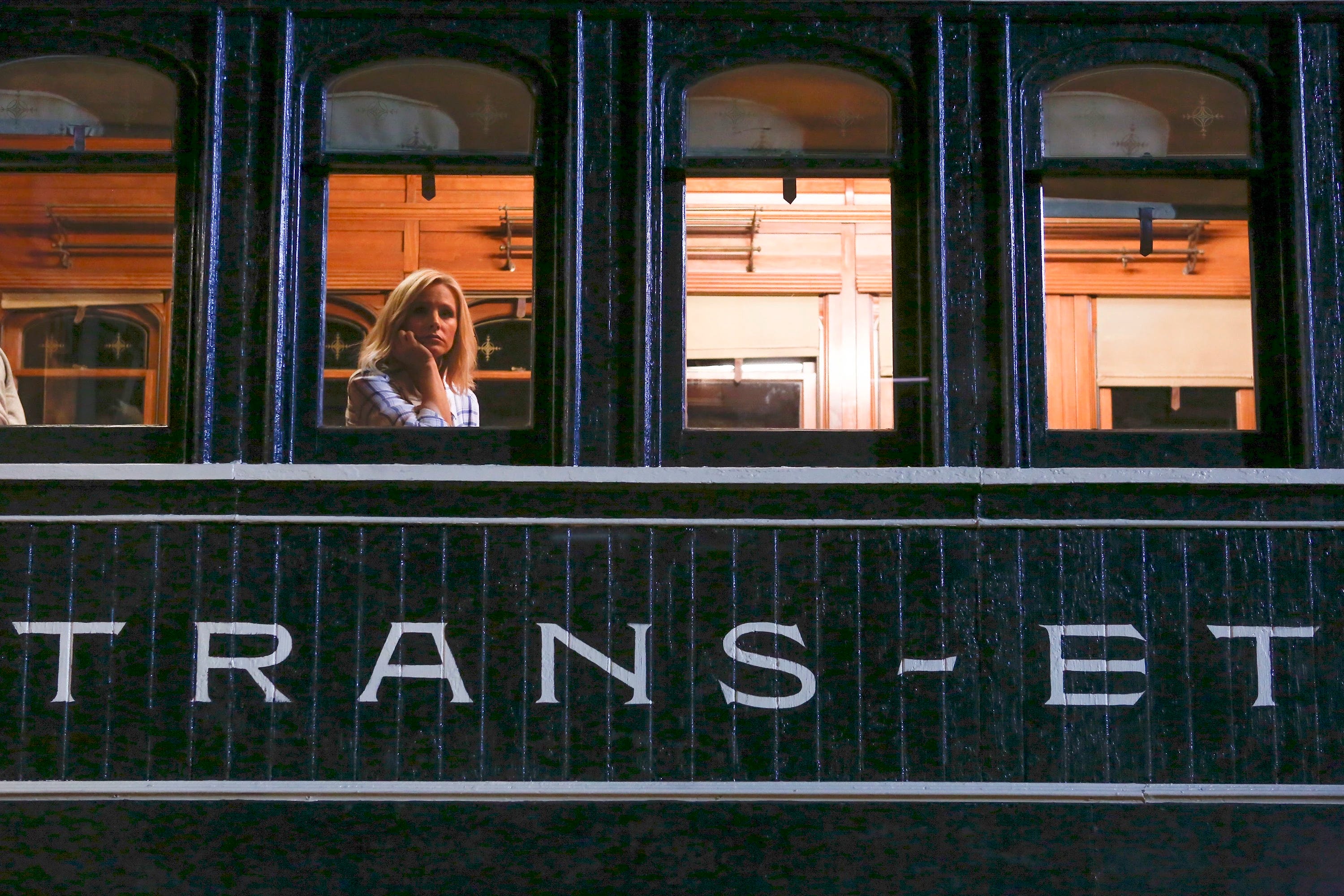
If we go further back in time, we may ask what vehicle was used for these metaphysical journeys before the invention of the boat. But we would be met with archaeological theories that the boat has potentially existed for up to 800,000 years, vastly predating our c. 6000 years of recorded history. This explains why the boat is so present in creation myths in which deities descend to a primordial Earth to create life.
In the same manner in which the Industrial Revolution has had a lasting impact on our world-building, so has the 1970s onwards, as the dawn of the Information Age and a pivotal era for molecular biology and space exploration. Retrofuturism — the defining cultural aesthetic of this era — is also increasingly employed in contemporary depictions of purgatory.
In the film Eternity (2025), characters arrive at a vast, brightly lit transit terminal that resembles an endless mid-century airport lounge suspended outside of time. The production design includes mid-century furniture, chrome panels and long, cavernous corridors that evoke both corporate futurism and metaphysical limbo. Similarly, in the Marvel series Loki (2021–2023), the titular character is arrested from his reality by the Time Variance Authority and brought to their headquarters, which exists outside the bounds of the linear flow of time because he did something that was not meant to happen. The setting of the TVA is a retrofuturist bureaucratic maze — an infinite government office built from 1960s Brutalist architecture, humming analogue machinery, pneumatic tubes, beige filing cabinets, dim amber lighting, and time-distorting elevators that make the space feel both outmoded and impossibly advanced.
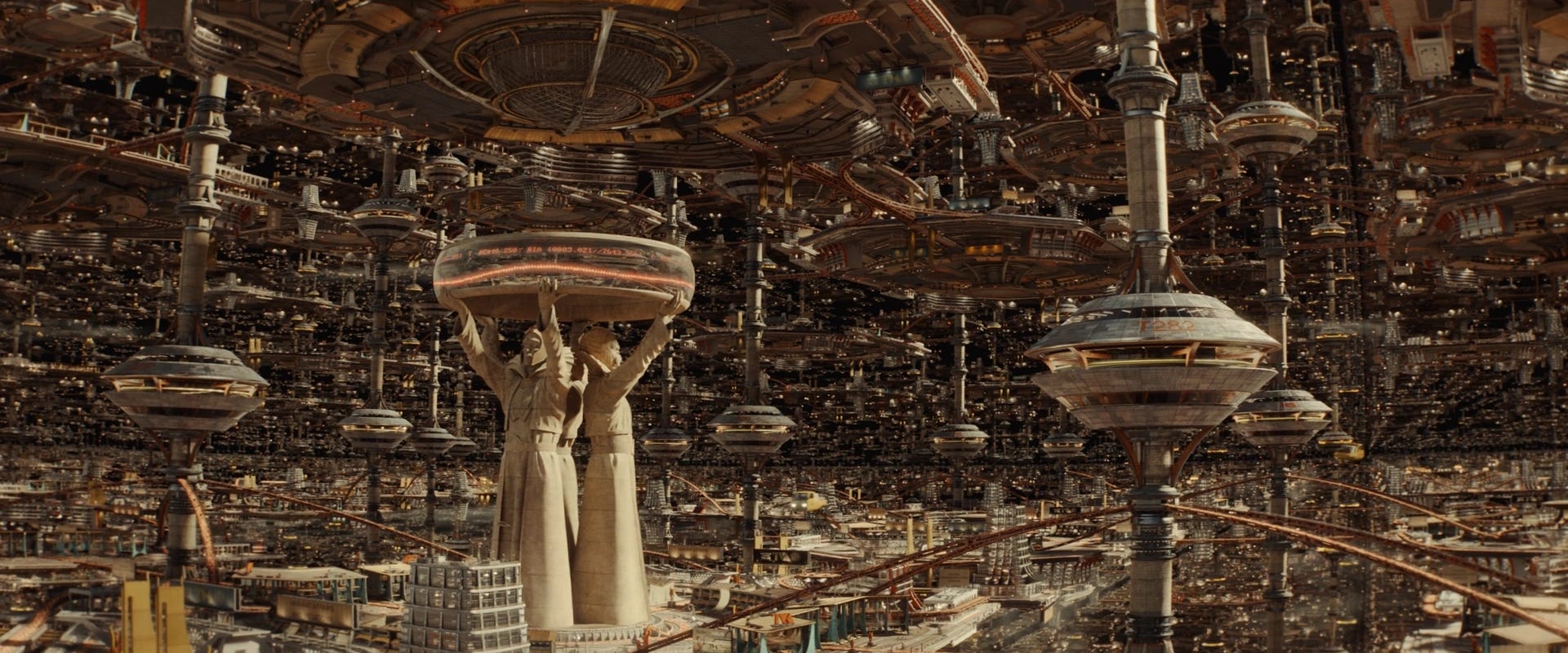
Retrofuturism has become a go-to cultural aesthetic for conveying a sense of temporal limbo because it is inherently disjointed in time. Retrofuturism is not simply about depicting the future; it is about what the past thought the future would look like. It embodies high hopes, material realisations and unexpected failures, as well as uncertainty and anxiety. Whether internally (in terms of psychedelics and molecular biology) or externally (with outer-space fascinations), people of that era were particularly concerned with what existed beyond their everyday perceptions of existence. Therefore, when conjuring a visual image of the Great Beyond, today’s production designers on media such as Eternity and Loki employ 70s retrofuturist aesthetics to illustrate a setting that exists outside the linear flow of time. In a way, designers have used retrofuturism to convey what people think the afterlife — as one’s uncertain future — would look like.
Another key element in these settings is liminal space. In The Spiritual Mechanics of Ó, I discuss the concept of a metaphysical waiting room between lives or between life and afterlife: purgatory. This state of in-betweenness is often echoed in spatial design by using long hallways and escalators — as they are in Eternity and In The Heights (2021), for example. The escalator replacing the stairway to heaven is another way in which technological evolution is reflected in our storytelling.
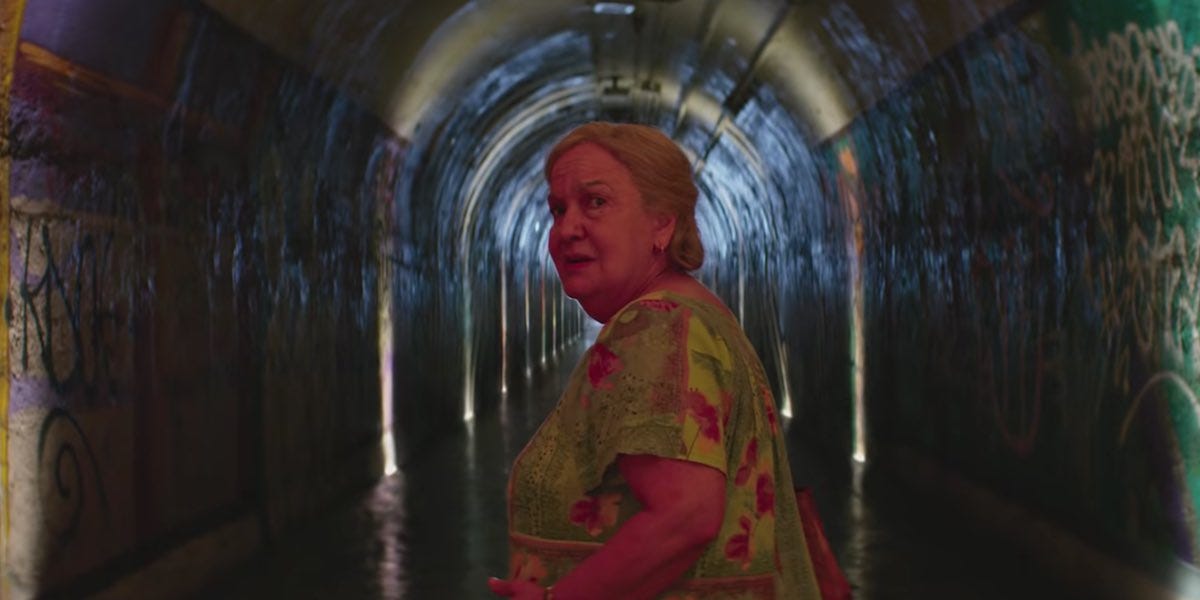
During Lin-Manuel Miranda’s musical film In The Heights, there is a sequence in which Abuela Claudia sings Paciencia Y Fe as her character passes on. This entire sequence exists outside the “real” events happening in the film. We know this because other characters are experiencing a citywide blackout whilst Abuela Claudia is seen in bed that night before the scene cuts to her taking a subway journey during the day. The brief ruse here is that it lets the viewer think she is having a flashback to just any other subway trip as she sings about longing for her homeland of Havana, when this scene is actually a cosmopolitan rendition of the metaphysical transit journey to the afterlife, where a subway train replaces the boat. In the final scene of this sequence, she walks into a light at the end of a long, graffitied hallway, signalling her death.
Increasingly, modern portrayals imagine the afterlife as a bureaucratic procedure with paperwork, queues, case files and audits, not as a divine kingdom free of these systems. Modern screen afterlives tend to reflect contemporary realities and anxieties about overwhelming systems and institutions, corporate architecture and administrative morality. These are afterlives shaped not solely by conventional angels and demons, but by our cultural fears about being trapped in systems, being misunderstood, or being indefinitely “processed.” This is echoed in the points system of The Good Place, the TVA’s paperwork-heavy process of determining one’s fate with hearings, and Eternity’s metaphysical “processing” and administrative oversight. These depictions critique contemporary society’s absurd rules and the inefficiencies of red tape, as well as moral absolutism and the traditional heaven/hell dichotomy.
Across these varied depictions of the afterlife, a clear pattern emerges: contemporary storytelling no longer imagines the beyond as a purely spiritual or mythological realm, but as a space shaped by the technological, architectural and ideological concerns of our own era. Whether through trains, subway lines, escalators, retrofuturist terminals, or labyrinthine bureaucracies, modern narratives translate ancient metaphysical journeys into forms that reflect today’s cultural anxieties and fascinations. The Industrial Revolution, the Information Age, advances in molecular biology, and our collective preoccupation with space exploration have all left unmistakable imprints on our visions of purgatory and the afterlife. These imagined realms become mirrors of the systems we live within: mechanised, administrative, disorientingly timeless, and saturated with the aesthetics of futures once imagined.
Yet at their core, these stories still express the same human impulse that shaped Duat, katabasis, and countless mythological journeys — a desire to understand what lies beyond the limits of perception and mortality. By blending ancient motifs with modern design languages, contemporary creators reaffirm that the afterlife remains a canvas upon which each era projects its deepest uncertainties, its evolving cosmologies, and its hopes for transcendence. In these hybrid worlds, the metaphysical journey endures, even as the vessels, architectures and atmospheres change.
Thanks for this, quite insightful and timely as one contemplates the specter of structural death of Black folk globally. The statistics online only depict North American data, yet here in South Afrika too, we are asking ourselves deep existential questions about whether Black Lives Truly matter. I am aware that your article is more philosophical, but this is the mental space I was already at as I read it, I had also been re-reading and translating an ancient Kmt text called the s4 hour vigil of Osiris, which deals with the mythopoetic mourning by the 'twin' goddesses Auset and Nbt-Het ...
Anikulapo is another netflixserie, and refreshingly unamerican, from Nollywood and heavy influenced by yoruba myth.